

Sciatica has a way of announcing itself. Perhaps you bent down to pick something up, or simply got out of the car after a long drive, and a few hours later a sharp, burning pain was running from your buttock down the back of your leg. For many people it’s the leg, not the back, that hurts most, which can feel confusing and worrying.
The good news is that most sciatica settles. The NHS notes that it usually gets better within a few weeks to a few months. In this article we explain what’s going on, what tends to help while it settles, what’s best avoided, and the few warning signs that mean you should get help straight away.
What sciatica is, and why it hurts down your leg
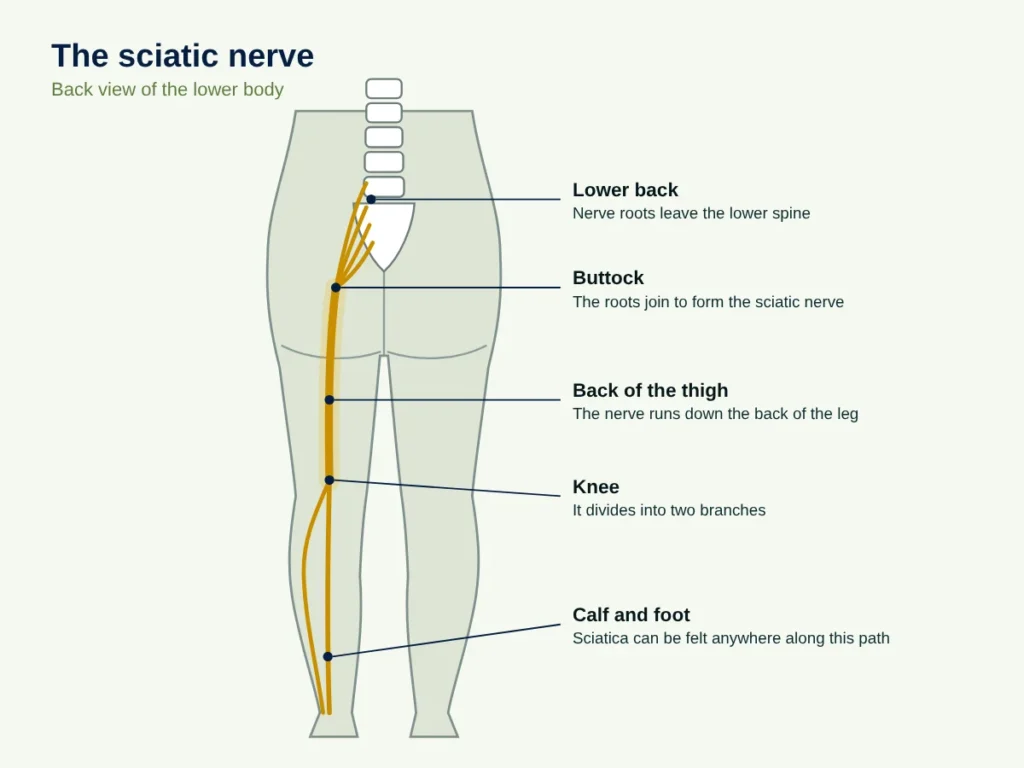
Your sciatic nerve is the longest nerve in the body. It’s formed from several nerve roots that leave the lower part of your spine, join together in the buttock and run down the back of each leg as far as the foot. When one of those roots is irritated or pressed on, most often by a bulging disc in the lower back, you feel pain along the path of the nerve rather than only where the problem started.
That’s why sciatica can show up in the buttock, the back of the thigh, the calf or the foot. It’s often described as sharp, shooting or burning, and it can come with tingling, pins and needles, numbness or a sense that the leg is weaker than usual. Sneezing, coughing or sitting for a long time can make it flare.
It’s worth knowing that “sciatica” describes the symptoms, not one single cause. Two people with the same leg pain can have quite different things going on, which is one reason a proper assessment helps if it isn’t settling.
What usually helps in the first few weeks
The instinct when something hurts this much is to rest it. With sciatica, though, staying in bed tends to slow recovery. Gentle movement is one of the most helpful things you can do, even when it’s uncomfortable. Short walks, keeping up your normal routine as far as you can, and changing position regularly all help. Movement can hurt without causing harm.
Long spells in one position are often the hardest part, particularly if you work at a desk or have a long commute. Getting up every 20 to 30 minutes, even just to walk to the kitchen, can make a real difference to how your leg feels by the end of the day. Some people find a heat pack on the lower back or buttock eases the muscle spasm that often comes with sciatica.
For pain relief, ask a pharmacist what’s suitable for you. Paracetamol on its own is unlikely to help sciatica much, so don’t be disheartened if it doesn’t touch the pain.
Simple stretches and gentle movements for the lower back are worth starting early too. The rule of thumb we give patients is this: some discomfort is fine, but stop any exercise that sends the pain sharply further down your leg.
What’s best avoided
Much of what makes sciatica worse is the opposite of the above. Days in bed, long stretches on the sofa and pushing through exercises that make the leg pain spread are all worth avoiding. While the pain is at its worst, it also makes sense to steer clear of heavy lifting and sudden twisting.
Many people also assume they need a scan. In fact most people with sciatica don’t, and NICE guidance advises against routine imaging. Scans often show disc bulges and “wear and tear” that are just as common in people with no pain at all, which can cause more worry than clarity. A scan is useful when the result would change what happens next, for example if surgery is being considered, and your physiotherapist or GP can tell you if that applies to you.
When to get urgent help
Very rarely, the nerves at the bottom of the spine are squeezed badly enough to affect the bladder, the bowel and both legs. This is called cauda equina syndrome, and it needs hospital treatment straight away. It’s uncommon, but everyone with sciatica should know the signs.
Go to A&E or call 999 if you have sciatica with any of these:
- sciatica in both legs
- severe or worsening numbness or weakness in both legs
- numbness around your genitals or anus
- difficulty starting to pass urine, being unable to pass urine, or losing control of your bladder, when this isn’t normal for you
- losing control of your bowels, or not noticing you need to go, when this isn’t normal for you
Don’t drive yourself to hospital if any of these apply.
When to see a physiotherapist
If your pain hasn’t improved after a few weeks, is getting worse, or is stopping you from working, sleeping or doing the things you normally do, it’s a good time to book an assessment. You don’t need a GP referral to see a physiotherapist privately, and a clear explanation early on can take a lot of the worry out of it.
What physiotherapy for sciatica involves
Your first appointment starts with a conversation. We’ll ask how the pain started, where you feel it, what makes it better or worse and how it’s affecting your day. Then we’ll check how you move, along with the strength, reflexes and sensation in your legs. Together these show whether a nerve is involved and rule out anything that needs medical attention.
From there, treatment is built around you. NICE guidance for low back pain and sciatica recommends exercise as the core of treatment, with hands-on treatment used alongside exercise rather than on its own. In practice that usually means exercises to calm the irritated nerve and help you move more comfortably, practical advice on sitting, sleeping and working positions, and hands-on treatment where it helps. As things settle, we’ll plan a gradual return to whatever matters to you, whether that’s the gym, five-a-side, gardening or a physical job.
Take a common example. Someone who sits at a desk all day might come in with leg pain that’s worst by mid-afternoon and makes the commute home miserable. Alongside their exercises, a big part of the plan could be as simple as how often they get up, how their chair and screen are set up, and building walking back into the day. Small changes like these, repeated consistently, often matter as much as anything we do in the clinic.
Throughout, we’ll explain what’s causing your symptoms, what to expect and how you’ll know it’s improving, so you’re never left guessing.
For more on general back pain, read Back and neck pain: when physiotherapy may help.
Book an assessment
Crestwell Medical has physiotherapy clinics in Stratford, Harrow, Finchley and Wood Green, open Monday to Saturday. Find out more about our back and neck pain clinic, or book an appointment or call 0203 916 5453.
Reviewed by Lorenzo Cavallaro, HCPC-registered physiotherapist
This article is general information, not a diagnosis. If you’re worried about your symptoms, speak to a healthcare professional.